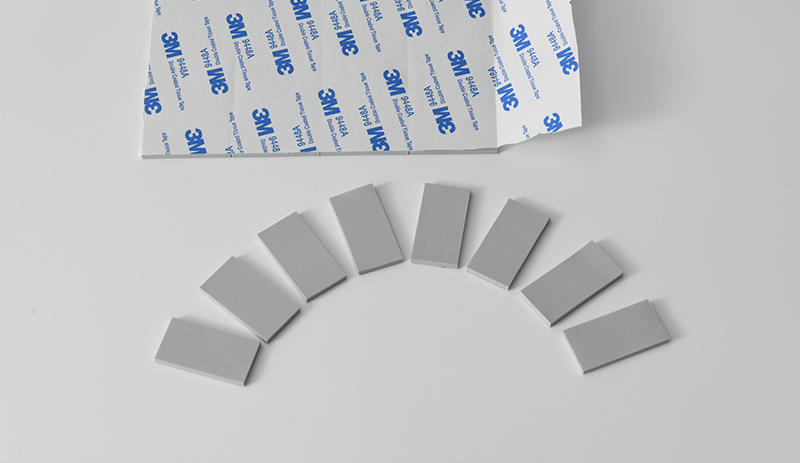
The selection of compression ratio for thermal conductive silicone pads should be comprehensively judged by combining material hardness, application scenario pressure, and heat dissipation requirements. The key points and suggestions are as follows:
I. Core Influencing Factors of Compression Ratio
Material Hardness (Shore Hardness)
Silicone pads with lower hardness (e.g., 20-30 Shore A) have better elasticity and ductility, allowing for higher compression ratios.
Products with higher hardness (e.g., 50-70 Shore A) are prone to reduced deformation capacity if over-compressed, so the compression ratio needs to be controlled.
Contact Surface Flatness
If the surfaces of the heating element and heat sink are rough or have large gaps, a higher compression ratio is required to fill the voids.
The flatter the surface, the lower the compression ratio can be appropriately set.
Assembly Pressure Limitations
When electronic components (such as chips) are sensitive to pressure, excessive compression ratio should be avoided to prevent component damage.
When the fixing pressure of the mechanical structure is small, the contact tightness should be adjusted through the compression ratio.
II. Recommended Compression Ratio Ranges and Application Scenarios
1. Conventional Electronic Devices (e.g., CPU, GPU Cooling)
Recommended compression ratio: 30%-50%
Explanation:
Take a 0.5mm-thick silicone pad as an example; the thickness after compression should be controlled at 0.25-0.35mm, which can fully fill the gap while avoiding excessive pressure on the components.
If the material hardness is 30-40 Shore A, a compression ratio of 50% is preferred; for hardness 50-60 Shore A, it is preferably 30%-40%.
2. High-Gap Scenarios (e.g., Gaps between Cooling Modules and Housings)
Recommended compression ratio: 50%-70%
Explanation:
Silicone pads with larger thickness (e.g., 1-2mm) and lower hardness should be selected. A high compression ratio is used to fill large voids, while the material's elasticity is utilized to maintain contact pressure.
3. Sensitive Components or Thin Devices (e.g., Mobile Phone Chips)
Recommended compression ratio: 20%-30%
Explanation:
Avoid excessive compression ratio causing component deformation. Prioritize thin (0.2-0.3mm), low-hardness materials to achieve close fitting through mild compression.
III. Precautions
Avoid Over-Compression
A compression ratio exceeding 70% may lead to uneven distribution of thermal conductive fillers inside the silicone pad, thereby reducing thermal conductivity efficiency. Additionally, long-term use may affect the service life due to elastic decay.
Dynamic Pressure Testing
After assembly, thermal cycle testing should be conducted to verify whether the compression ratio is appropriate. If the thermal conductivity effect fluctuates or components deform, the compression ratio should be adjusted or the material replaced.
Summary
The optimal compression ratio for thermal conductive silicone pads typically ranges from 20% to 70%. The core principle is to ensure sufficient gap filling while avoiding excessive pressure on components. In practical applications, an initial value of 30%-50% can be tested first, and then fine-tuned according to the heat dissipation effect and structural compatibility.
PREV:Thermal conductive silicone sheet designed specifically for electronic products
NEXT:Which fields or industries commonly use thermal conductive ceramic tiles?

QQ客服1
QQ客服2
13713346890
dg_jnkj@163.com