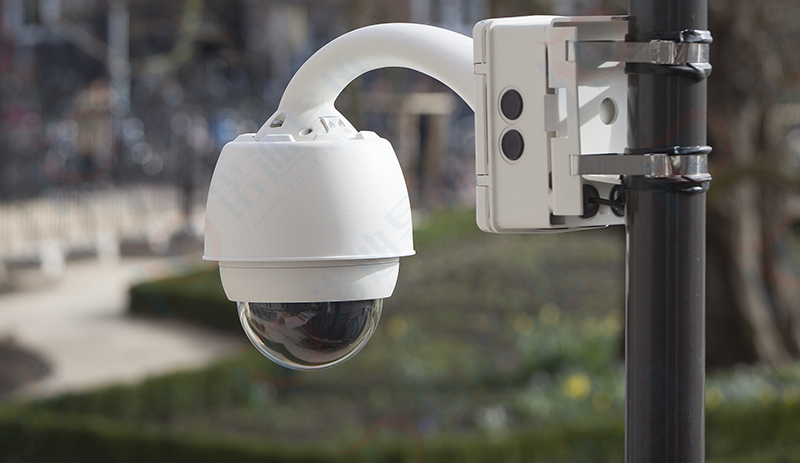
In modern security systems, surveillance cameras, as critical visual perception devices, efficiently capture environmental information relying on semiconductor imaging technology. Core components such as CCD and CMOS sensors are widely applied in the public safety field due to their advantages of high sensitivity, strong resistance to strong light interference, low distortion, compact size, long service life, and vibration resistance. Especially in outdoor scenarios, cameras need to be exposed to extreme environments for a long time, enduring wind and rain erosion and drastic temperature fluctuations, thus placing strict requirements on the reliability of heat dissipation systems.
Infrared fill light technology is an important support for ensuring the imaging quality of surveillance cameras at night, but it also brings significant heat dissipation challenges. Take a common 50-piece ¢5 specification infrared lamp panel as an example: after 12 consecutive hours of operation, the surface temperature of the LED panel can soar to about 90°C. High temperatures not only directly threaten the service life of the infrared lamps themselves but also damage the adjacent CCD image sensors. As core components converting optical signals into analog current signals, the performance of CCD sensors directly determines the quality of image acquisition, storage, and transmission. Once overheating causes signal noise or data distortion, it will seriously weaken the security efficiency of the surveillance system. In addition, heat accumulation in memory modules and power modules will also affect the operational stability and service life of electronic components, so efficient heat dissipation has become a core issue for ensuring the stable operation of cameras.
At present, the heat dissipation solutions for surveillance cameras are mainly divided into two systems: passive heat dissipation and active heat dissipation. Passive heat dissipation increases the contact area between heat sources and air by optimizing heat sinks, housing structures, etc.; active heat dissipation enhances convection efficiency through devices such as fans and liquid cooling. Regardless of the technical path, thermal conductive materials are key elements in building efficient heat transfer channels. Among them, thermal conductive silicone pads have become the preferred solution in the industry due to their excellent comprehensive performance. Their compressibility and flexibility enable them to perfectly fill the narrow spaces inside cameras, ensuring stable heat conduction while providing shock absorption and buffering, and effectively avoiding local overheating caused by material displacement. Meanwhile, the characteristics of low volatility and high thermal conductivity, combined with low thermal resistance design, can quickly direct heat to heat dissipation structures, significantly reducing the operating temperature of core components.
In terms of product characteristics, the thermal conductivity of Dongguan Nuodi's thermal conductive silicone pads ranges from 3.0 to 12.0W/mK, meeting the heat dissipation needs of devices with different power levels; the self-adhesive design simplifies the assembly process and improves production efficiency; the highly elastic material can still maintain good adhesion in low-pressure environments; the wide temperature range adaptability from -40°C to 180°C ensures stable operation in extreme climatic conditions.
As surveillance technology accelerates its evolution toward high definition and intelligence, the industry's demand for thermal conductive materials is undergoing significant upgrades. The iteration from 720P to 1080P, 4K, and even higher resolutions means that image processors will generate more heat, pushing the performance requirements for thermal conductive materials to the 6W-12W level.

QQ客服1
QQ客服2
13713346890
dg_jnkj@163.com